


The short answer
Most ice maker failures in high-end refrigerators come from a water supply problem, a failed inlet valve, a frozen fill tube, a faulty sensor, or a worn ice maker module, and most of these can be repaired without replacing the refrigerator. We diagnose the cause on site, explain the options, and repair Sub-Zero, Viking, and Thermador ice makers in Carson and nearby cities.
When the ice maker in a built-in refrigerator stops working, the cause is usually a single small part: a valve, a sensor, a frozen line, or a clogged filter. Sub-Zero Repair Specialists repairs ice makers in Sub-Zero, Viking, and Thermador built-in and integrated refrigerators, plus freestanding undercounter ice machines, for homeowners in Carson and nearby cities such as Torrance, Gardena, Long Beach, Lakewood, and Compton. Many of the kitchens we visit also have Wolf cooking equipment, and we service that too. We are an independent repair company, not affiliated with or endorsed by any appliance brand. This page covers the problems we see most often, what our technician checks, and how a visit works.
Issues we fix
Ice maker problems tend to show up gradually. Output drops, the cubes look wrong, or water appears where it shouldn't. These are the symptoms homeowners describe most often:
- No ice at all, even though the freezer is cold
- Ice production slowed to a trickle, or the bin never fills
- Small, hollow, or misshapen cubes
- Ice clumped into a solid block in the bin
- Ice that tastes or smells off
- Water leaking under the refrigerator or into the freezer
- A frozen or iced-over fill tube
- The ice maker keeps making ice after the bin is full
- Clicking, buzzing, or grinding when the ice maker tries to cycle
- Error codes or warning lights tied to the ice maker or water system
- Undercounter ice machines that won't drain, overflow, or let the bin fill with water
- A freezer that isn't holding temperature, which stops ice production
What our technician checks on a built-in unit
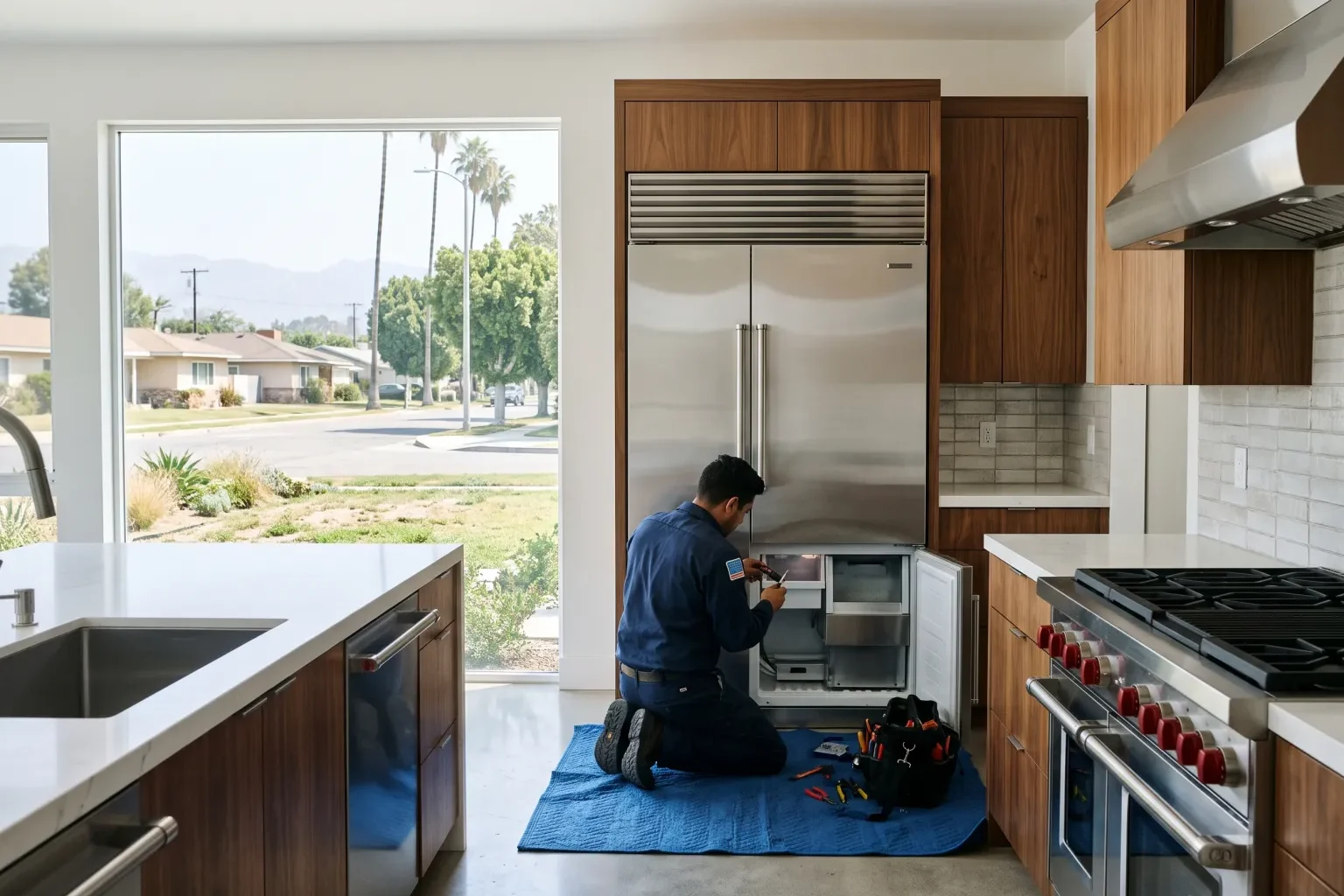
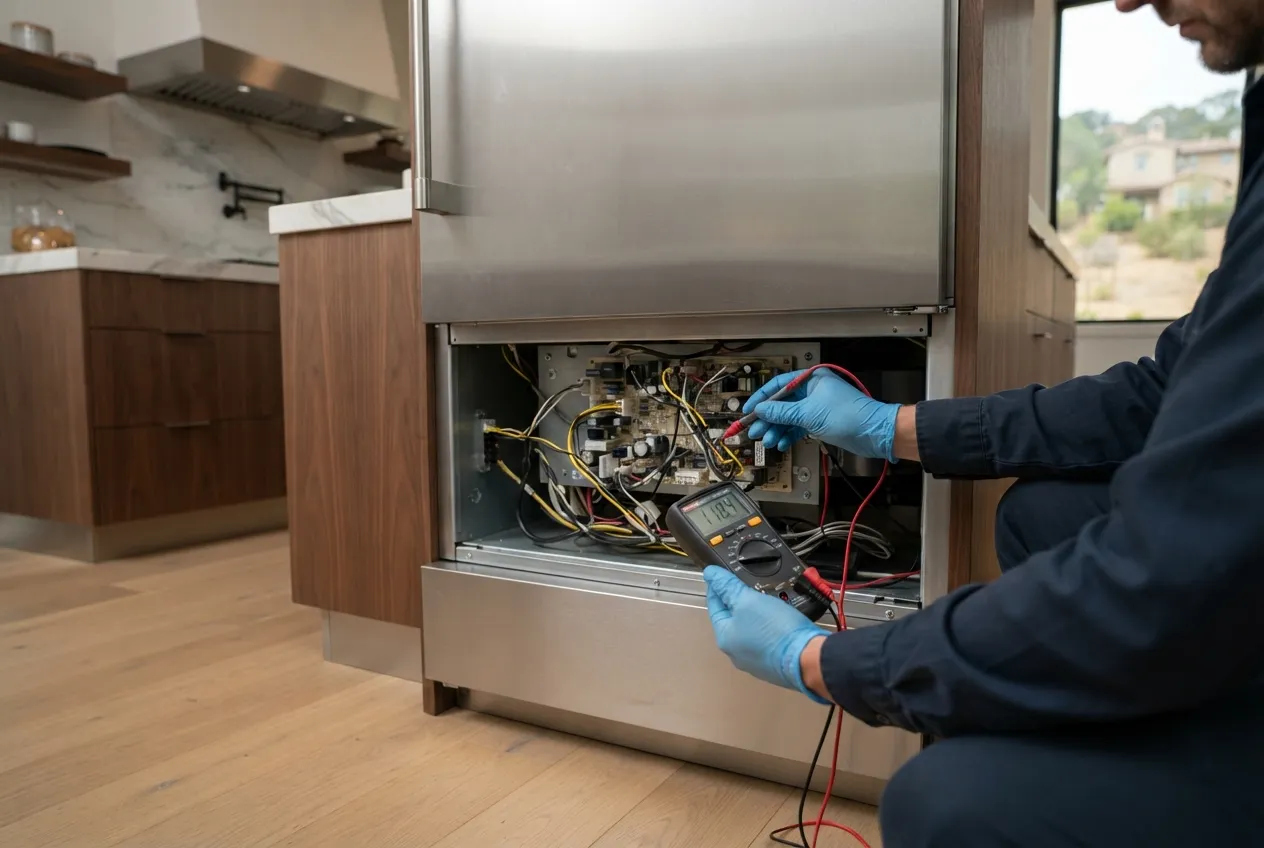
An ice maker depends on the whole refrigerator, so we don't just swap the ice maker module and hope for the best. We start with the water supply: household water pressure, the shutoff valve, the supply line behind or beneath the unit, and the water filter. A clogged filter or kinked line is one of the most common reasons for small cubes or slow production.
Next we test the water inlet valve and look for ice in the fill tube, which often points to a valve that drips or a low freezer temperature setting. We check freezer temperature and airflow, the door gaskets, and frost on the evaporator, since a freezer that runs warm will slow or stop ice production. Then we test the ice maker itself: the mold heater, the thermostat or thermistor, the ejector motor, and the bin-full sensor or arm. On undercounter ice machines we also inspect the drain, the drain pump if there is one, the water distribution system, and the condenser, which needs clear airflow to work properly in a tight cabinet opening.
Heat makes all of this harder. Inland and valley neighborhoods get much hotter in summer than areas near the coast, and fall Santa Ana winds can bring hot, dry spells. On those days a weak ice maker or a dusty condenser is the first thing to fall behind.
How Sub-Zero, Viking, Wolf, and Thermador ice makers differ
Sub-Zero built-in and integrated refrigerators use ice makers that rely on steady water flow and an accurately controlled freezer. The repairs we see most often involve water filters, inlet valves, frozen fill tubes, and ice maker modules that stop cycling. Sub-Zero undercounter ice makers are separate appliances, and their problems more often involve drains, pumps, and cleaning cycles.
Viking built-in refrigerators share many of the same water-side issues: restricted filters, valves that stick open or shut, and ice makers that stall partway through a harvest. Viking undercounter ice machines need clean condensers and clear drains, so ventilation in the cabinet opening matters.
Thermador built-in and column refrigerators run their ice makers through electronic controls. Along with the usual valve and filter checks, sensor faults and control-board communication problems come up more often, and an error code can help point us toward the right part.
Wolf is Sub-Zero's sister brand for cooking, so Wolf doesn't make ice makers. Many Carson-area kitchens pair Wolf ranges, ovens, or cooktops with a Sub-Zero refrigerator, and we can look at both on the same visit.
Tell us what your appliance is doing.
Repair or replace a high-end refrigerator?
A failed ice maker is rarely a reason to replace a premium built-in refrigerator. These units are designed to be serviced. The ice maker module, valve, sensors, and filter housing can usually be replaced on their own, and the cabinet, sealed system, and paneling stay in place.
Replacement starts to make sense when the ice maker problem is a symptom of something larger, such as a sealed system failure, repeated compressor problems, or extensive water damage. It can also make sense when parts for an older model are no longer available. If we find one of those situations, we'll explain what we found and what each option involves so you can decide.
What affects the cost of an ice maker repair
We can't give a fair figure until we know the cause, and the cost depends on a few factors. The first is the fault itself. Replacing a water filter or clearing a frozen fill tube is a much smaller job than replacing an ice maker module, an inlet valve, or a control board.
Parts are the second factor. Brand-specific components for Sub-Zero, Viking, and Thermador vary in cost and availability, and some have to be ordered. The third is access. Integrated refrigerators with custom panels, and undercounter ice machines set into tight cabinetry, can take more time to reach the supply line, valve, or drain. Water damage to surrounding cabinets or flooring is a separate matter and isn't part of the appliance repair.
How a visit works
When you contact us, tell us the brand, the model if you have it, and what you're seeing: no ice, small cubes, leaks, or an error code. We'll schedule a visit at your home in Carson or a nearby city.
Our technician will inspect the water supply, the freezer, and the ice maker, then explain the cause and your options before any work begins. If the part is on hand, many repairs are finished during the first visit. If a brand-specific part needs to be ordered, we'll schedule a return visit to install it. Before we leave, we run the ice maker through a cycle to confirm it fills and harvests, and we check for leaks.