


The short answer
Most freezer problems on high-end built-in units come from fans, defrost parts, sensors, door seals, drains or ice makers, and these are usually worth repairing. We diagnose the cause on site, explain your options and the cost before any work starts, and give you a straight answer when replacement makes more sense.
A freezer that stops holding temperature puts a lot of food at risk. On a built-in or column unit, the fix is rarely as simple as pulling it away from the wall and swapping a part. We repair freezers in Carson and nearby cities, including Torrance, Gardena, Long Beach, Lakewood and Wilmington. Our focus is Sub-Zero, and we also work on Viking and Thermador refrigeration, plus the Wolf cooking equipment that often sits alongside it. We are an independent repair company, not affiliated with any manufacturer. This page covers the symptoms we see most, what our technician checks, how the brands differ, and how we help you decide whether a repair makes sense.
Issues we fix
Freezer trouble usually shows up gradually. Food that is softer than usual, a new noise or a patch of frost is often the first sign of a larger problem. If you notice any of the following, it is worth having the unit looked at before it fails completely.
- Freezer running but not cold enough, or ice cream and frozen food turning soft
- Frost or ice building up on the back wall, the evaporator cover or around the door opening
- Water pooling under the unit, or a sheet of ice forming in the bottom of the cabinet
- Ice maker not producing ice, making small or hollow cubes, or leaking
- Unit running nonstop, or cycling on and off much more often than before
- Clicking, buzzing, rattling or a loud fan
- Error codes, a flashing display or a temperature alarm that will not clear
- Door that will not close fully or seal tightly
- Freezer section dead while the refrigerator section still works, or the reverse
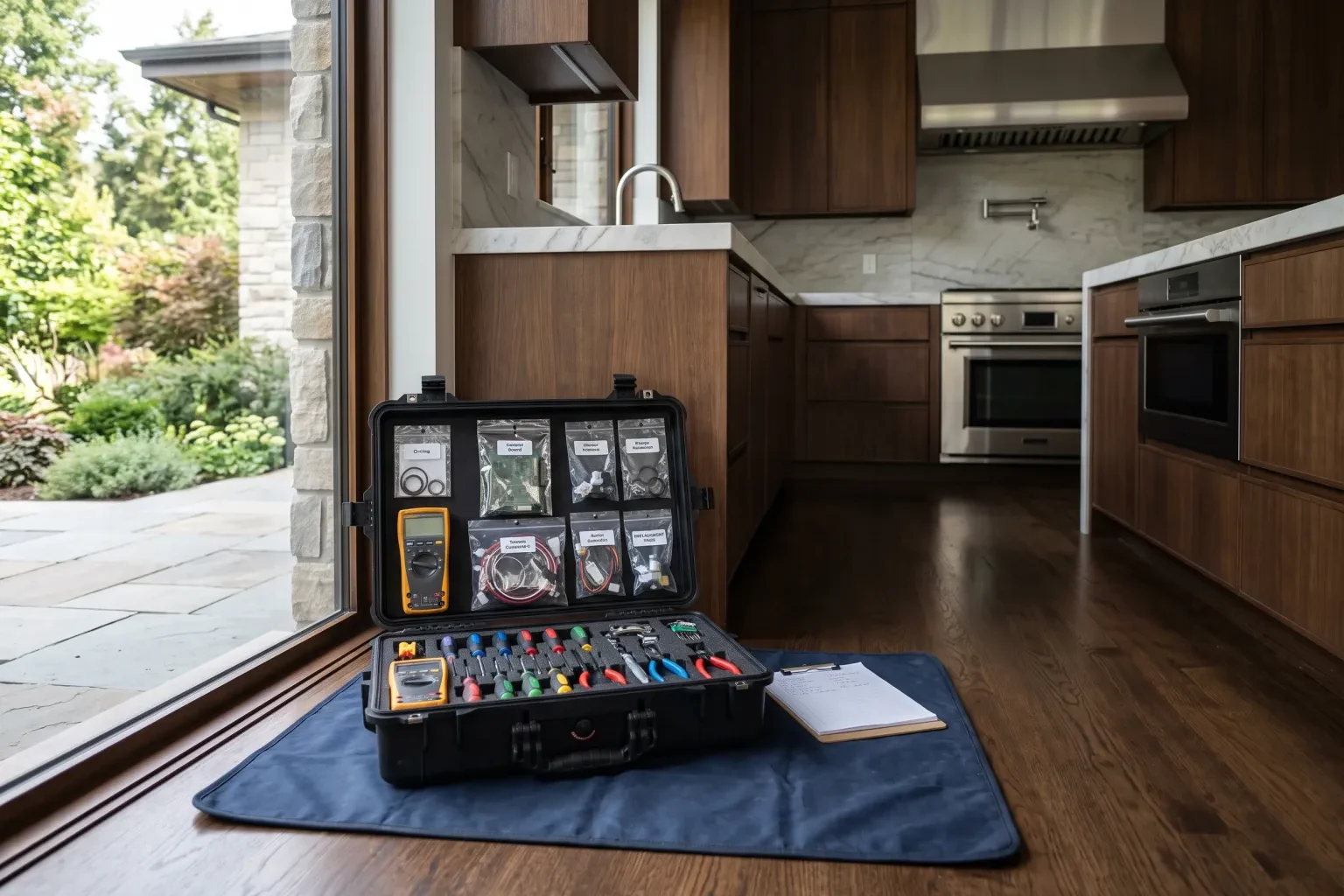
What our technician checks on a built-in or professional-style freezer
Built-in freezers are packed tightly into cabinetry, so a good diagnosis follows a set order rather than guessing at parts. Our technician starts with the condenser coils and condenser fan. On many built-in units these sit at the top, behind the grille, where dust and kitchen grease collect and make the system work harder. Next comes the evaporator fan, which moves cold air through the cabinet. When it fails, the freezer can run constantly and still warm up.
We test the defrost system: the heater, the termination sensor and the control that runs the defrost cycle. A defrost fault is one of the most common reasons frost builds up and airflow stops. We also check the temperature sensors, door gaskets and hinges, the drain line and drain pan, and the ice maker and water valve. Where the control supports it, we read the stored diagnostics.
If the evidence points to the sealed system, such as a refrigerant leak or a compressor that will not start, we confirm that carefully before recommending that kind of work. We also look at the installation itself: level, ventilation clearance at the grille, and whether the unit is getting enough airflow to shed heat.
How Sub-Zero, Viking, Wolf and Thermador freezers differ
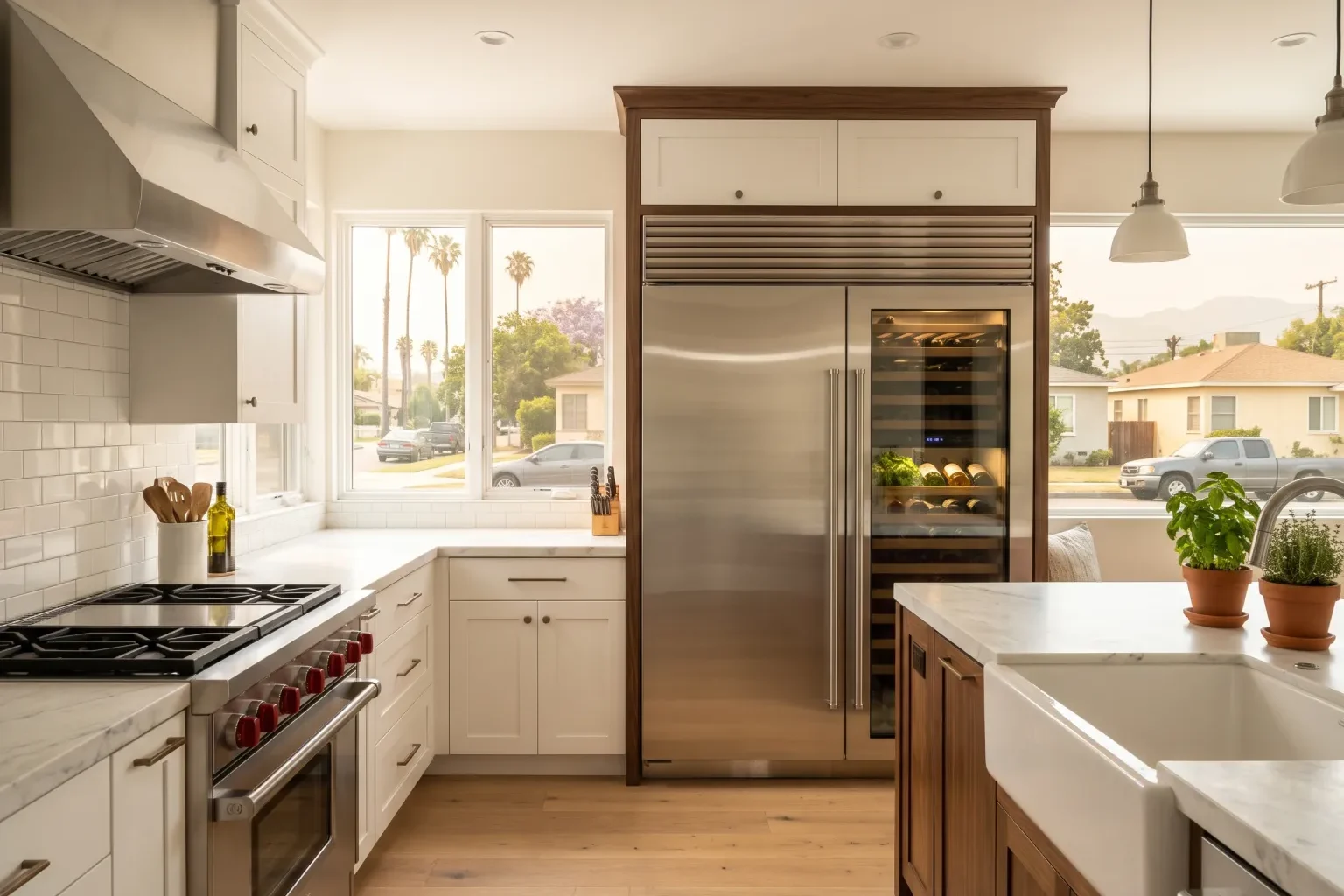
Sub-Zero built-in and column freezers are the core of our work. Many Sub-Zero models use separate refrigeration systems for the fresh-food and freezer sections, so a freezer problem can show up while the refrigerator side keeps working normally. Top-mounted condensers that need cleaning, worn door gaskets, ice maker faults and defrost components are the issues we see most often.
Viking built-in freezers often come to us with door alignment and hinge wear, fan motors, ice makers and control issues. Thermador column freezers rely heavily on electronic controls and sensors. Ice makers, defrost faults and drain problems are common reasons for a visit. Wolf builds ranges, ovens and cooktops rather than freezers. We service those too, and because Wolf cooking equipment is so often installed next to a Sub-Zero, we can handle both in the same kitchen.
Local conditions matter as well. Los Angeles summers are dry, inland neighborhoods run much hotter than the coast, and fall Santa Ana winds can bring hot spells. A freezer in a warm garage, or one with clogged coils, has to work harder during those stretches. That is often when weak parts finally fail.
Tell us what your appliance is doing.
Repair or replace a high-end freezer?
Premium built-in freezers are designed for a long service life, and they are custom-fit to your cabinetry and panels. Replacing one means finding a unit with matching dimensions, and sometimes adjusting the cabinetry. For most failures, including fans, sensors, gaskets, defrost parts, ice makers and controls, repair is usually the practical choice.
The harder call is a sealed system failure on an older unit. In that case we look at the unit's age and overall condition, whether parts are still available, whether other major components are wearing out, and how a replacement would fit your space. We explain what we find plainly and let you decide. We do not push a repair that is not worth doing.
What affects the cost of freezer repair
Every repair is different, so we give you a specific cost after diagnosis and before any work begins. These are the main factors:
- The fault itself: a gasket or sensor is a simpler job than sealed system work
- Parts: whether a part is readily available or has to be ordered from the manufacturer
- Access: panel-ready units and tight custom cabinetry can take extra time to open or pull out safely
- More than one problem: for example, a failed defrost heater that also led to a frozen drain line
- Follow-up visits: needed when a part has to be ordered and installed later
How a freezer repair visit works
When you book, tell us the symptoms and, if you can, the model and serial number. These are usually printed on a rating plate inside the unit, near the top or along a side wall. That information helps us bring the right parts. Our technician arrives, protects your floors and cabinetry, and diagnoses the problem.
Before starting any repair, we explain what we found, your options and the cost. If the part is on hand, we can often finish the repair the same visit. If not, we order it and schedule a return visit.
While you wait for your appointment, keep the door closed as much as possible and move important food to another freezer or a cooler. Check that the breaker has not tripped. Do not chip away ice with sharp tools, because that can puncture the evaporator.